











WASHINGTON D.C.
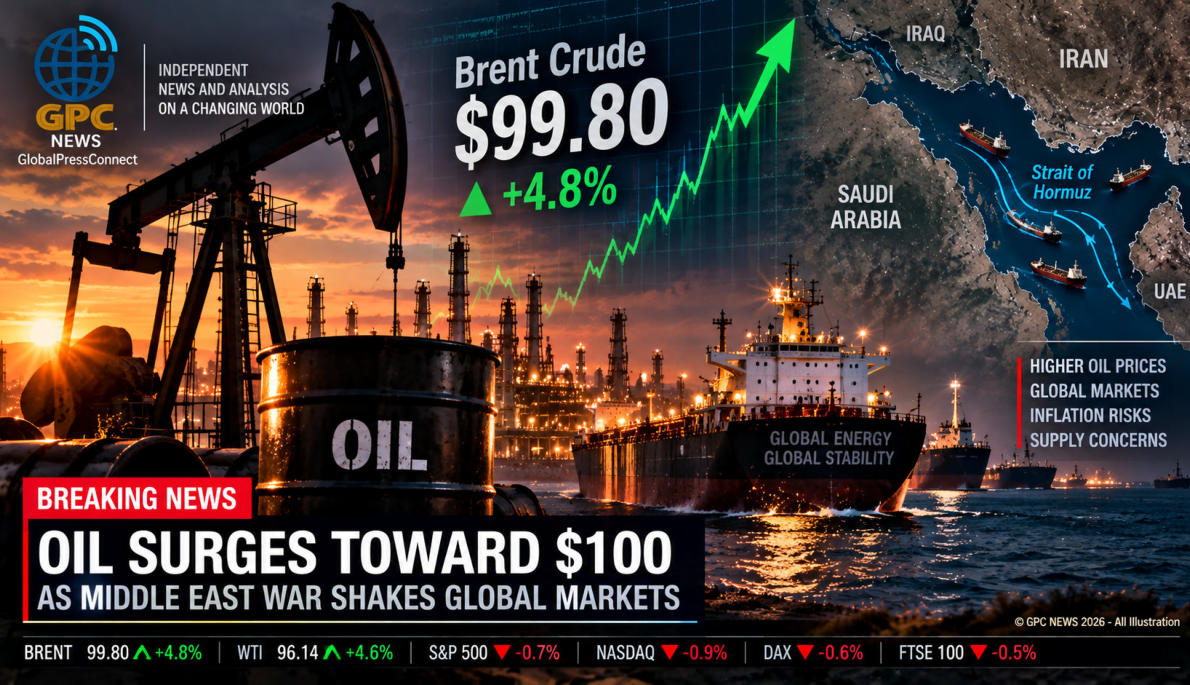
Global Press Connect provides independent news and analysis on international  politics, the economy, and humanitarian developments. © 2026 GlobalPressConnect | GPC.NEWS Founded and operated by Simone Mayer & Helping Hands for Children Foundation Inc. | Los Angeles, California, USA GlobalPressConnect (GPC.NEWS) is an independent international news organization dedicated to delivering accurate, impartial, and timely journalism. Our mission is to provide verified reporting, editorial integrity, and in-depth coverage of global affairs, politics, business, financial markets, technology & AI, entertainment, humanitarian issues, weather, and breaking news. All Rights Reserved. OIL SURGES TOWARD $100 AS MIDDLE EAST WAR SHAKES GLOBAL MARKETS    LONDON / NEW YORK — September 8, 2026 — GPC.NEWS  Global oil prices surged on Tuesday, moving toward the psychologically important $100-a-barrel level as the widening Middle East conflict intensified fears of serious disruption to energy supplies. Brent crude climbed sharply as traders reacted to attacks on Saudi Arabia, heightened tensions involving Iran and growing uncertainty over commercial shipping through the Strait of Hormuz, one of the world's most critical energy corridors. The latest escalation has transformed geopolitical risk into an immediate concern for financial markets. Saudi Arabia is among the world's largest crude exporters, while the Strait of Hormuz carries enormous volumes of oil and liquefied natural gas from producers including Saudi Arabia, Iraq, Kuwait, Qatar and the United Arab Emirates.  Any prolonged interruption to those flows could quickly tighten global supplies. Oil traders are therefore adding a substantial risk premium to prices even before the full economic consequences of the latest military escalation become clear. The effects are spreading beyond energy markets. Higher crude prices increase transportation and manufacturing costs and could revive inflationary pressure in economies that have spent years attempting to bring price growth under control. Persistent energy Inflation could also complicate decisions by the U.S. Federal Reserve and other major central banks over future interest-rate policy.  Stock markets were also under pressure as investors assessed the possibility that a prolonged Middle East conflict could weaken global economic growth while simultaneously pushing inflation higher. Airlines, transportation companies and other fuel-intensive industries are particularly exposed to a sustained increase in energy costs. For consumers, the consequences could eventually appear at petrol stations, in airline fares and in the prices of goods transported across global supply chains. Much now depends on whether energy exports from the Gulf continue to move normally and whether the Strait of Hormuz remains accessible to commercial shipping.  A temporary geopolitical shock can send oil sharply higher. A genuine interruption to Gulf energy exports would be considerably more serious. With military tensions spreading across the region, global markets are once again watching every tanker, pipeline and oil installation in the Middle East. GPC.NEWS continues to monitor oil prices, global markets and developments across the Gulf.  © 2026 GPC.NEWS — GlobalPressConnect MARKETS & ECONOMY